
Inside ‘A Discovery of Witches’ Tudor Fashion with Costume Designer Sarah Arthur

Updated: Sep 9
After a day of fabric sourcing for a new project, Sarah Arthur jumps into her car and picks up the phone. She enthusiastically dives into a story about how a cancelled order of silver embroidered fabric became the basis for one of Diana Bishop’s iconic dresses on A Discovery of Witches.

The costume designer, renowned for her Emmy-nominated work on Sherlock, brought to life Elizabethan garments worn by its lead stars, Teresa Palmer and Matthew Goode. Set in 1590, season two of the fantasy series (based upon the novels by Deborah Harkness) sees Diana and Matthew transported to the Tudor era. They continue hunting for the Ashmole 782 manuscript, which allegedly holds the secrets to why the supernatural population is diminishing. As the story is rooted in history, there was extra pressure to represent the period accurately.
“Deborah Harkness was absolutely adamant that we get it right because a lot of these characters in that season were based on existing real-life well-known people. It was very important to get the authenticity correct,” Arthur tells us. But where do you begin such a tremendous undertaking?
According to the designer, it all starts with the fabric and trims. “When you're doing a period drama, especially something that far back, it's important that all your fabrics look natural and not synthetic.” She also cites working closely with the author, who was “incredibly helpful, she knows everything!”
Arthur is known for obtaining material overseas, which fuelled the connection to history, as back then, only the wealthy could import such expensive items. “I do a lot of fabric buying in the Czech Republic and my contact sources them from Italy, India and all over the world. But one day, she had a cancelled order of silver embroidered fabric, which I ended up buying and making one of Diana's dresses out of, which was very exciting.”
The team even incorporated custom dyed materials and old Victorian lace (as Elizabethan lace is no longer available) into the clothing. “Lace manages to sort of defy time really, and carry-on living,” Arthur says. “I use a lot of Victorian lace because you can't get that quality now that isn’t incredibly expensive.”
The Differences In Dressing Tudor Men And Women
While Diana’s Farthingale skirts have a large physical presence, Matthew’s attire is the stark opposite. For men, short capes and deep form V doublets are the way to go. When Matthew meets Queen Elizabeth in episode nine, he’s dressed very formally. This is very reflective of Elizabeth’s court. It was often referred to as the ‘Peacock Court’ as men dressed up to impress the Queen. Arthur confirms the change in Matthew’s wardrobe for those scenes, “When you went to see the queen you had to wear a collar, the ruffle and velvets. Matthew in everyday clothes, was quite rugged, which suited him. But then he did have to dress up for those royal appearances.”


If you look closely, there is also a reason why Diana’s clothes match Matthew’s in terms of quality. Sumptuary laws back then outlined what you couldn’t wear, but the upper classes were often exempt. Originally introduced by Henry VIII, Queen Elizabeth extended these laws to women, who had to dress according to their husband’s status. As Matthew comes from a wealthy family, Diana was privy to the same exceptions. Certain colours and materials were banned for those of lower stations, and so Diana wearing her silver gowns proves her rank.

The Process Of Creating Queen Elizabeth’s Wardrobe
Queen Elizabeth I appears in the series, played eloquently by Barbara Marten. As a renowned monarch, she had a fabulous wardrobe.
Unfortunately, most of the Tudor fashion did not survive the decades. Many items were repurposed or sold off by the Stuarts and even perished in the Great Fire of London. This meant that Arthur and her team used portraiture when creating the costumes. In episode three, where Diana and Matthew have an audience with the Queen, references to the Ditchley portrait in the dress (namely the jewelled white motifs) are evident. The designer revealed that she didn’t want to be literal with the interpretations. She instead looked at several paintings; hence, the dress also holds some resemblance to the Armada portrait.

Arthur’s commitment to authenticity knows no bounds. Even when faced with the task of creating an additional dress for Queen Elizabeth, no shortcuts were taken. “Originally, we were supposed to do one dress for her. And then suddenly, they decided to write her into another episode, which threw us a little because that was very time-consuming. But it was important to get it correct. Her costumes were magnificent. And they were all hand embroidered, hand bejewelled, and that's exactly the process we went through. About eight to ten people were working on this one dress for about two weeks. It was a lot of work. Of course, when you're recreating somebody as significant as Elizabeth it has to resemble what people recognize from these portraits and I hope it did.”

Diana’s fashion in France and Prague
As Diana and Matthew travel through Europe during the season, the clothing had to reflect that journey. Starting in London “which was very black and white in 1590. Queen Elizabeth wore a lot of black and white and they had to follow suit” says Arthur. “Then we went to France but that was sort of a hidden land. And so, we looked at rich greens and browns."

The final step was to realise Rudolf’s vibrant style in Prague. Those garments were colourful, with golds, oranges and purples taking charge.
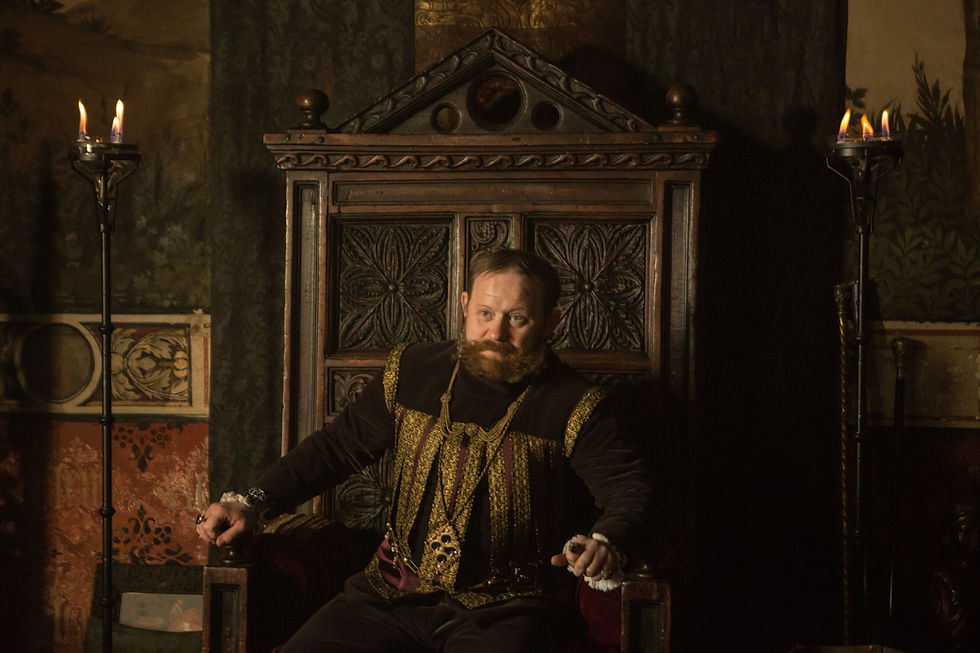
“From that side of things, it was exciting as Diana's wardrobe then became quite large because we weren't shooting in episode order either. After we created all these beautiful gowns, I was concerned that it may have looked a bit like a fashion show. But in fact, I was very pleased when I saw the end result,” Arthur continues.
Crossover into Season Three
Season Two ends with Diana and Mathew travelling back to the present day. The outfits played a crucial part in visually presenting this to the audience. The reason Matthew wears leather trousers, for instance, is because they are timeless. "That was an interesting design feature because I wanted it to feel correct for Elizabethan times. But I wanted it to not look out of place in current time”, explains Arthur. This is shown in the season three trailer where the duo timewalk once again. Sarah Arthur’s dedication to upholding history this season made the viewing experience all the more special. To transport an audience to a different time without the garments coming across as fancy dress is no easy feat. Above all, the costume designer proved with this project that her designs are unparalleled in the genre.
This interview was originally carried out by That Fiction Life for The Tempest in 2021. As that site is no longer active, the article has been reporter here on the official site for That Fiction Life.


Comments